
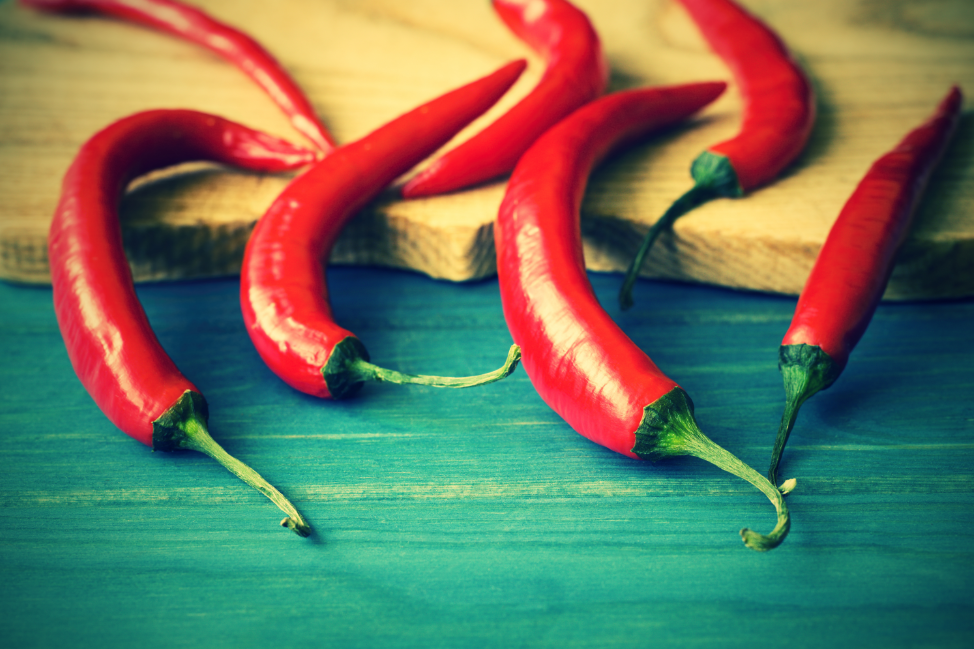
Ever hear the kitchen advice that says if you want to reduce the heat from a pepper, you need to first remove the seeds? That’s wrong. In fact, most of the capsaicin in a pepper is located not in the seeds, but in the pith – the white material inside the pepper that surrounds the seeds. So, while removing the seeds will reduce the heat of the pepper, it will only do so if you take the pith with them. How does capsaicin synthesis work in the fruit of the pepper plant?
What Is Capsaicin?
Capsaicin is a familiar word, but you might not actually know what it is. Really, it’s nothing more than a chemical found in certain plants (their fruit). This chemical is thought to be an adaptation to avoid mammalian predators from consuming the fruit, as their teeth would crush the seeds. Birds, which are not affected by the heat-producing effect of capsaicin, are better at distributing the seeds as they are not crushed during consumption. There is also the fact that capsaicin acts as an antifungal agent, and can help protect developing fruit against mold and other fungal threats.
Where Does Capsaicin Synthesis Take Place?
While capsaicin can be found in all the flesh of the pepper (but not the seeds), synthesis takes place exclusively in the plant’s placenta during initial growth, called the interlocular septum. Biosynthesis happens in the fruit’s glands, and relies on the condensation of vanillylamine with acyl-CoA moiety.
Eventually, capsaicin spreads through the growing fruit. However, it is most heavily concentrated in the material that surrounds and holds the seeds in place (probably the reason that cooks recommend removing the seeds in the first place). Interestingly, you can actually use your tongue to detect the highest concentrations of capsaicin in the pepper by simply running it over the different areas. The highest concentrations will have the most heat, while lower concentrations will feel cooler to the tongue.
How Does Capsaicin Synthesis from Plant to Product Work?
Many of the products (but not all) on the market that use capsaicin today use a naturally derived version of the chemical. This must be extracted from the pepper itself. The synthetic version is made in a lab, and because it does not incur a lengthy leeching and synthesis process, is more affordable.
Extracting capsaicin from peppers requires a multi-step process. Generally, the peppers must first be processed, generally by cutting them into very small pieces. This can be done at home in a food processor. Next, those pieces must be soaked in a carrier liquid. This can be done with alcohol, such as vodka or grain alcohol, or it can be done with other oils. However, if the final product is intended for ingestion, the carrier material should be safe to eat or drink. The pepper pieces will need to be soaked and agitated for several days, and then the liquid will need to be strained away from the pieces. The alcohol (or other liquid) will now contain most of the capsaicin the peppers once held.