
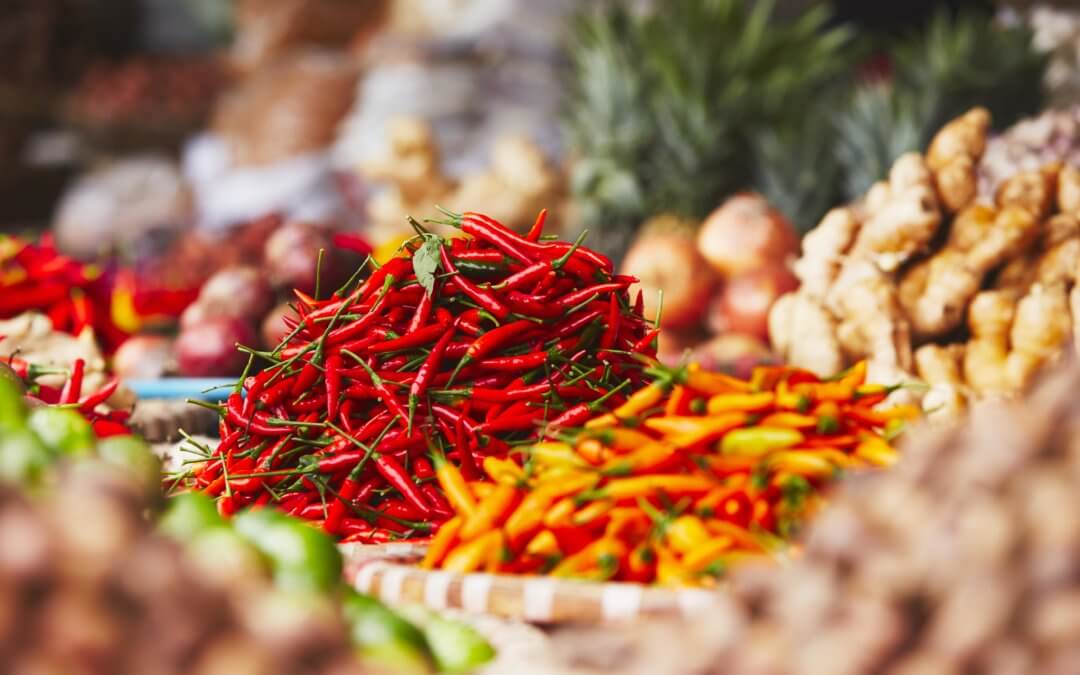
Have you ever found yourself wondering about the chemistry behind spicy food? If you didn’t even realize that spiciness was due to chemistry, you aren’t alone. In fact, everything about the way we quantify, consume, and grow chili peppers is all about chemistry. The chemical in peppers, capsaicin, is what allows us to use peppers and spices for medicinal purposes, and to make our meals tasty. This article probably won’t be any fun for anyone who never enjoyed Bill Nye, but I’ll do my best to make all this science talk interesting.
Why Bother?
If you haven’t really thought about chemistry since high school, you’re probably wondering why you should keep reading. Here’s the thing: there are some pretty incredible medical trials going on right now utilizing peppers with capsaicin. We already know that capsaicin is an effective, natural pain reliever, that can produce effects similar to that of morphine. We also know that, despite popular wives’ tales, capsaicin actually helps to heal stomach ulcers and can be used to boost metabolism.
But did you know that there is significant evidence to show that capsaicin is an effective cancer fighter? Or that capsaicin has been shown to reduce high blood pressure and get rid of artery-clogging plaque? Within the next few years, there’s a very high possibility that capsaicin could be revealed as a leading ingredient in a cancer cure. If that’s not enough to make you wonder what it is about this little chemical that is so powerful, I’m not sure what will.
Capsaicin Classification
The component of a pepper that makes it so hot is a family of chemical compounds. This family is called capsaicinoids, with the main player in this family being capsaicin. Here’s an interesting fact: capsaicin also part of another family of compounds called vanilloids, meaning – you guessed it – spicy peppers are related to vanilla due to the way their chemicals are made up.
Capsaicin is made up of hydrogen, carbon, oxygen, and cobalt. While you’re probably familiar with the first three, cobalt isn’t something you may have heard mentioned often in the world of food. In its chemically combined form, cobalt is a metallic material that can be turned into a deep blue dye. It is also the active chemical in vitamin B, and is used in the production of gamma rays.
The reason that capsaicin and vanilla are in the same family of chemicals is that they each create a similar chemical reaction when they come into contact with the mucous membrane of the mouth, eyes, nose, and throat. There are other chemical compounds in these two families, such as dihydrocapsaicin, which are also found inside peppers with capsaicin. When it comes to understanding the heat of a pepper, capsaicin and dihydrocapsaicin are the two compounds that really matter.
Receptors and Reactions
Any opening of your body that allows the outside to come into contact with your innards is lined with a mucus membrane. This membrane contains tiny cells called trigeminal cells, which exist solely to create and release a chemical into the blood that announces when something is hot. The chemical released whenever capsaicin comes into contact with a trigeminal cell is called substance P. You can think of substance P as a messenger, racing along in the blood to alert your brain that the mouth is in serious discomfort right about now.
The brain doesn’t want any part of your body to be in discomfort. Our brains are actually very concerned with the amount of pain we feel; even when you believe you are feeling the worst pain of your life, your brain is actually shielding you from a large portion of the sensation. The true amount of pain that your body is capable of feeling would make you pass out very quickly.
So, when the the brain gets the message from your friendly neighborhood substance P, the first thing it does is attempt to remedy the situation, by sending out a bunch of pain-blocking chemicals. Dopamine and endorphins flood your system immediately, making you feel content, even relaxed, and pain-free. Instead of burning hot sensations, you’ll probably feel a mild buzzing or numbness in the mouth or lips once the reaction between the capsaicin and the trigeminal cells has resulted in a rush of hormones.
(This is why you may often feel the same burning sensation in the bathroom after you eat a spicy meal. Capsaicin is not digested, but rather passed through the body. The mucus membrane lining the anus works in the same way as the membrane of the mouth, with trigeminal cells to announce the arrival of capsaicin.)
If you put your trigeminal cells through this process enough times, they will eventually develop a sort of confusion to the presence of capsaicin. Think of these cells as tiny puppies, who get a good treat every time they bark at the neighbor’s cat. Eventually, the puppy will want to see the cat all the time, because he knows a treat is coming when he does. Your mucus membrane cells act in a similar way; they know that when they come into contact with peppers with capsaicin in them, they’ll get a dose of feel-good hormones. And this reaction is what causes a craving for spicy food. Next time you crave spicy food, consider the kind of day you are having, or what your environment is like. Are you stressed out, or having a rotten time? Could be that your body is craving spicy foods as a way to balance stress with some endorphins.
How Do Peppers Make Capsaicin?
Not all peppers have capsaicin in them. For example, bell peppers have none, which is why they taste sweet rather than spicy. All the compounds in the capsaiciniod family, including dihydrocapsaicin, are produced by glands inside a pepper’s pod walls. The pod is the fleshy part of a pepper that you eat, by the way. So “pod walls” are just a more specific way of saying the flesh of the pepper. Inside this flesh are special glands that produced capsaicin.
This production is very uneven in most peppers. You probably won’t ever find a pepper that has exactly the same amount of capsaicin in every square millimeter, if it was even possible to measure that. Many people believe that seeds are what make a pepper spicy, and will cut out the seeds when cooking, believing that they’ve reduced the heat of the dish. But actually, the spiciest part of any pepper is usually the white pith that surrounds the seeds. Seeds can absorb some capsaicin, of course, so they may be hot to taste. But don’t think that you’ve turned a spicy dish mild by getting rid of seeds alone.
Capsaicin Characteristics
Using peppers with capsaicin is typically one of the easiest, and tastiest, ways of putting some heat into your food. But there are many reasons, for food, medicine, and more, that people need pure capsaicin. Because this has become a common ingredient in everything from pepper spray and gourmet desserts to pest repellant and pain reliever, we know a bit about the characteristics of pure capsaicin when it is removed from the pepper.
First, capsaicin is odorless, tasteless, and colorless. You may be thinking, “Wait, it can’t be tasteless – it tastes spicy!” But “spicy” actually isn’t a flavor, it’s a sensation of heat. There is no specific taste related to spicy, just the taste of the other ingredients in the dish. These characteristics make pure capsaicin valued for cooking. Gourmet chefs add it to desserts to give them exotic heat without ruining the sweet flavor; others add it to dinner dishes to add extra heat without adding the flavor of peppers.
Capsaicin is an oily substance that repels water. This is why taking a drink of water after eating peppers with capsaicin doesn’t do much good. The properties of this compound simply push the water away, and may actually make the spiciness worse, because the water will carry the capsaicin around to other parts of your mouth. There, the chemical reaction with pain receptors starts all over, and you get a brand new rush of substance P saying “ouch!” This characteristic is why capsaicin is used as the main ingredient in pepper spray. It isn’t easy to wash off, won’t cool down due to any resulting tears, and can’t be sweated off. This makes it ideal for self-defense or riot control.
Pure capsaicin is also completely unchanged in heat level by cooking it, freezing it, or grinding it. The only way to make a dish that contains capsaicin less spicy is to use less capsaicin (or fewer capsaicin-containing ingredients). Additionally, the only way to make a dish spicier is to add more capsaicin. There is no way to manipulate the heat of a particular amount of capsaicin. Certain peppers contain more capsaicin than other peppers, so if you know that you like a specific level of spice, it’s a good idea to get familiar with which peppers contain the most – or the least – amount of capsaicin.
How to Measure Heat
To understand how hot a pepper is, you need to know how much capsaicin is inside the pepper. There are several ways to measure this characteristic, but the most popular is the Scoville scale. This scale uses a measurement called a Scoville unit, designed by a pharmacologist named, what else, Wilbur Scoville.
This scale is considered very unscientific, because it relied on a subjective taste test in the original creation. Today, we typically used the high-pressureliquid chromatography (HPLC), a laboratory test that detects the capsaicinoid concentration in a pepper by separating the capsaicin from the liquid in the pepper through a pressurized process.
The problem with the HPLC is that the measurement is denoted as ppm, or “parts per million”, something that most people won’t really understand. The Scoville unit is popular because it’s very easy to understand. Less than 1,000 is a not-very-spicy pepper, more than 1,000,000 is a flaming hot pepper, and everything in between is relative to other peppers. It’s very easy for someone to understand that a jalapeño is less spicy than a habanero pepper because the habanero has a higher Scoville score.
Luckily, there’s a pretty easy way to estimate a pepper’s Scoville unit score if you only know its HPLC rating. Simply multiply the HPLC rating by 16, and you’ll get within the correct range on the Scoville unit scale.
The most widely known “spiciest pepper in the world” is the Ghost chili; but every year, peppers that aren’t available for commercial consumption measure hotter than this pepper. In any case, law enforcement grade pepper spray tends to rate around five times higher on the Scoville unit scale than the hottest known pepper, and pure capsaicin is much, much hotter than that. That is why handling pure capsaicin is an extremely delicate operation. Laboratory workers who use pure capsaicin typically work in fully sealed suits with ventilated breathing apparatuses and a variety of protective layers.
Chemistry Class Was Never This Fun
Understanding what’s going on inside the reaction between capsaicin and your body is actually a pretty interesting thing for lovers of spicy food. The next time you feel the burn, followed by the pleasant tingling and the boost in energy that comes with eating spicy foods, you’ll know exactly what happens. You’ll also understand how to choose the right pepper based on how spicy you want your meal.
This information has an even more important meaning, though. By understanding how capsaicin works to help the body release powerful natural hormones, the medical community is able to not only treat pain and other symptoms, but it may also reveal the link between nerves, hormones, and certain diseases like diabetes and cancer. The more we know, the better our health will be in the future – all because someone along the way wanted to know why a tasty-looking plant made their mouth burn when they ate it. Pretty neat, right?