
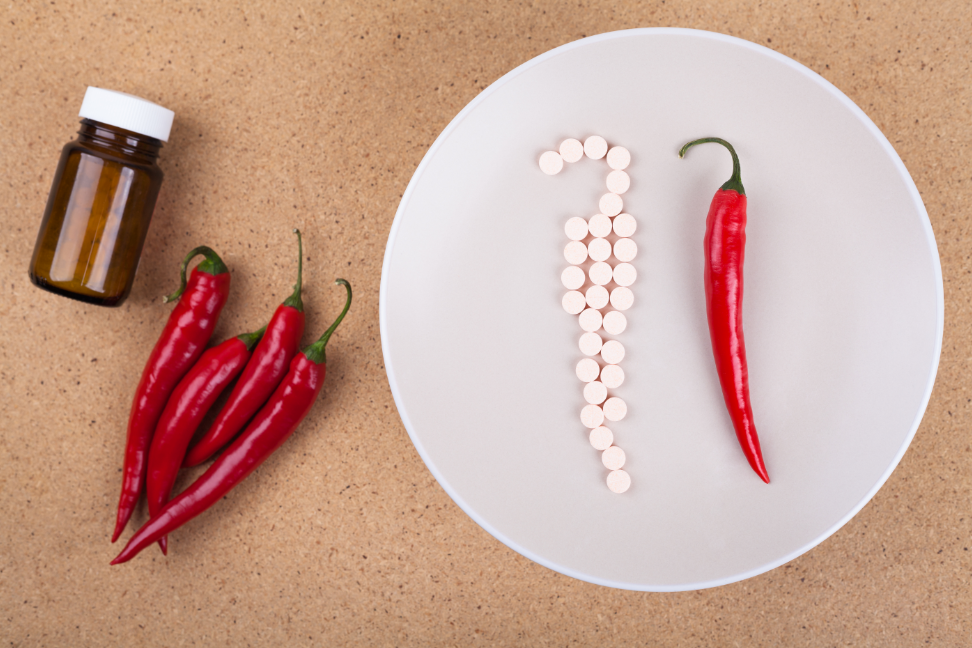
If you’ve ever bitten into a pepper and suddenly felt like your mouth was on fire, you’re familiar with capsaicin. However, this phytochemical actually offers a lot of benefits that go beyond spicing up your food. Peppers have been used medicinally for a long time, and there’s good reason for that. Capsaicin medical uses are far more numerous than you might be aware. What are they?
Capsaicin Medical Uses: More Than a Spicy Bite
A quick glance at the market will show you that capsaicin’s medical users are wide and varied. This is due to the chemical’s many properties. So, where might you find it used?
Pain Relief: While you might take an aspirin to alleviate those sore muscles after a long run, or to ease the pain from a pulled muscle, you can also use creams and ointments. Many of these use capsaicin as the active ingredient for its analgesic (pain relieving) properties. Most creams and ointments on the market use .075% capsaicin, but you’ll find some that contain up to .25%. It’s recommended to start with the lower dosage until you determine that it is not enough. If you are still experiencing discomfort, increase to the .25% dosage.
These products can be used for more than just muscle soreness, though. You can use them to combat lower back pain, as well as for cluster headaches and even to help ward off the pain of arthritis. Even patients suffering from debilitating rheumatoid arthritis and osteoarthritis can experience pain relief.
In addition to creams and ointments, you’ll find patches on the market. These can be used to treat the same conditions as those other products, but because they’re adhesive, they offer more utility. High concentration patches containing up to 8% capsaicin have become available for treating neurological pain, as well.
Other Capsaicin Medical Uses
In addition to use as a topical analgesic, there are other capsaicin medical uses, both current and emerging. For instance, it is being studied for use in potentially preventing and possibly even treating some forms of cancer. It has been shown to be effective in laboratory testing, but no human tests have been conducted as yet.
Capsaicin has also been implicated in helping to control appetite and boost metabolism. While the actual mechanism here is not well understood, this use has significant ramifications for those suffering from obesity, and obesity-related diseases, including cardiovascular disease, hypertension and preventing stroke. As with potential treatments for cancer, little clinical testing has been conducted on the effect of capsaicin on metabolism and weight gain when taken orally, although the limited studies are promising.
Should You Use Capsaicin?
Capsaicin is an effective analgesic, and in low concentrations, is very effective at managing pain in a topical application. However, it is always a good idea to discuss using any supplement or medication with your physician prior to beginning its use. It’s also worth noting that, while rare, some people do have a sensitivity or allergy to capsaicin.
Source:-
https://www.ncbi.nlm.nih.gov/pubmed/9179523
https://en.wikipedia.org/wiki/Capsaicin#Research_and_pharmaceutical_use
http://www.webmd.com/drugs/2/drug-4181/capsaicin-topical/details
http://www.webmd.com/pain-management/tc/capsaicin-topic-overview#1